
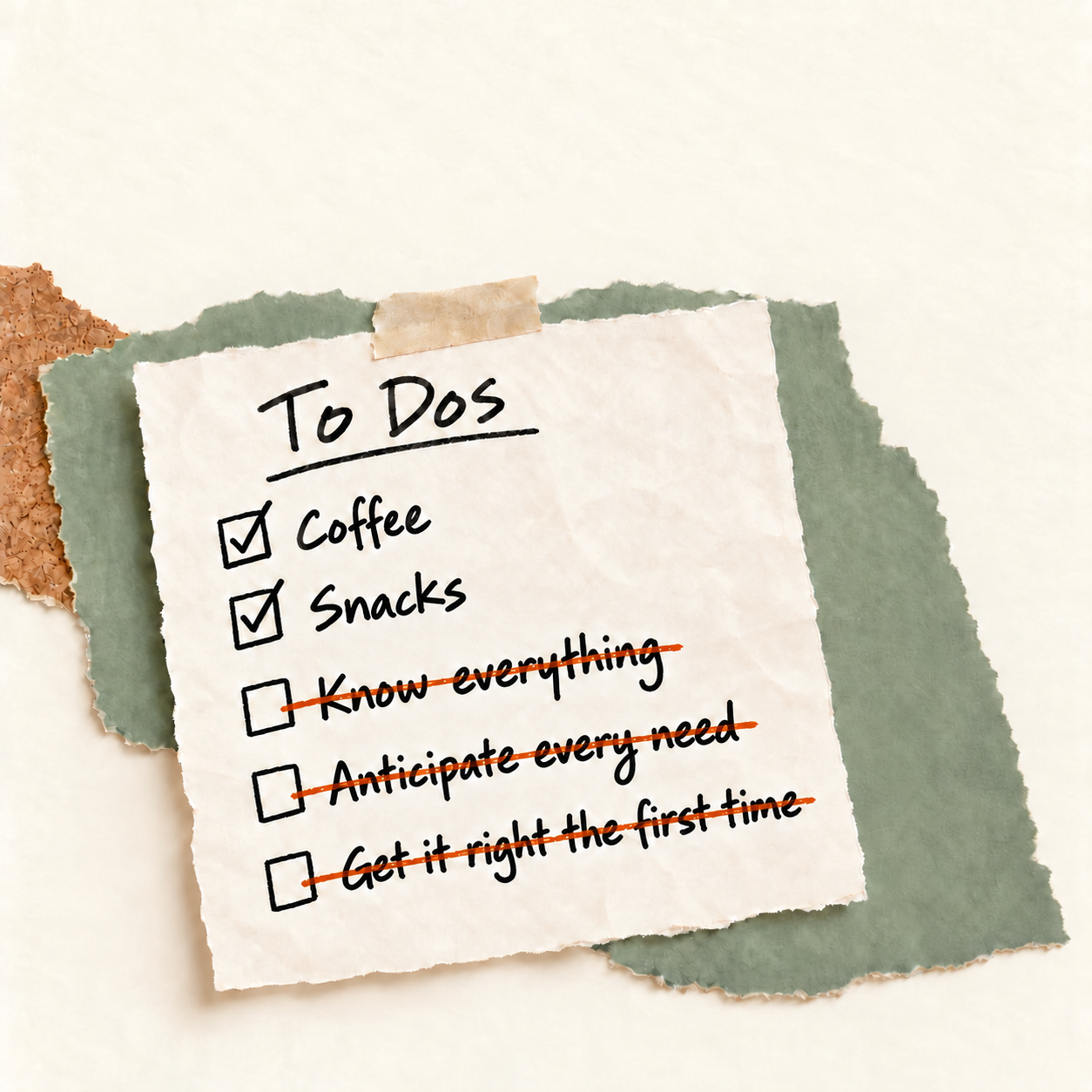
Existential crisis in aisle 9
Like a lot of us, I try to squeeze as much out of my week as possible. Between work and three kids’ extracurricular activities, meal planning has been one of my winning strategies. Every Sunday, I sit down and figure out what we can realistically eat that week. Then I grocery shop once and get it out of the way.
But last Thursday I realized that we didn’t have enough food to make it through the weekend (teenagers, am I right?). Of course, the easy thing to do would be to make a list, go to the store, and get the food. Instead I had a minor existential crisis.
After 17 years of practice, shouldn’t I be better at this? Where was I going to find another hour to go shopping? Could we eat nothing but ramen and Pirates Booty for 3 days? Did I need to come up with a whole new system for meal planning? And actually, why wasn’t I just perfect the first time?
Instead of just going to the store I turned it into a verdict on my ability to manage my life.
When did once a week become the right answer?
Thankfully, instead of continuing to berate myself I got curious: Who said I could only grocery shop once a week?
Certainly not my husband. He doesn’t care when or how often I go, as long as we have coffee and snacks. My kids hadn’t imposed a weekly shopping limit, either. I’m sure some image of the mother who has everything together had worked its way into my thinking. But I had also developed my own definition of what an effective, productive person looks like. Someone who plans ahead, anticipates all needs, and uses time wisely.
Over the years, a routine that helped me get by had become a requirement I measured myself against. Shopping once a week meant I had planned well. Going back meant I had fallen short. The useful part was meal planning. The less-than-useful part? Adding a verdict about myself.
What is an invisible rule?
I’ve been calling these expectations invisible rules: beliefs we’ve turned into requirements for ourselves, with a judgment attached to falling short. Mine sounded like this: “As a good planner, I should anticipate everything my family needs for the week. If I need another trip, I didn’t plan well enough.”
I wasn’t consciously repeating that sentence every Sunday. I noticed it through the disappointment and hesitation I felt when I needed to do something differently. Once I started asking other people about the requirements they held themselves to, plenty of examples surfaced. And I began noticing how often mine showed up at work.
The rules that came to work with me
When I started a business, I brought along expectations I’d developed over years of working inside organizations. Some were useful. Others deserved another look.
One was my rule about expertise. Being prepared and understanding my subject matter has served me well throughout my career. I took pride in knowing the work, anticipating questions, and giving people thoughtful answers. But when I looked closer, I realized “be prepared” had become “know everything before you put yourself out there.”
And when I started posting more regularly on LinkedIn and writing blogs, that rule snuck up on me. I have ideas and experience worth sharing. Then I start thinking about everything I haven’t read, every angle I haven’t considered, and every question someone might ask. So I research, outline, read another article, toss my original outline and start fresh. The judgment underneath it is that if I miss something people will discover I’m not a credible expert.
A task that could have taken a day stretches into two weeks.
Preparation matters to me. But I’m questioning the rule that I have to eliminate every possible gap before I’m allowed to contribute. And I’m noticing where else useful standards have become requirements I use to judge whether I’m doing a good enough job.
Looking closer, I could see how some of these rules helped me feel safe. If I anticipated every need, I could avoid making a mistake. If I knew every answer, I could avoid having my credibility questioned. In a way, I was judging myself first to avoid being judged by someone else.
But that protection came at a cost. I value efficiency, yet I was spending time questioning my competence over an extra errand. I wanted to contribute something useful, yet I was delaying it until I could contribute something beyond criticism.
I still want to plan ahead and do thoughtful work. I’m learning to give myself more room in how I do both.
For this blog, that means being prepared enough to offer a useful perspective, knowing there will always be more to learn.
For groceries, it means accepting that sometimes five people eat more food than I expected. I can go back to the store without treating it as evidence that I’m losing at life.
Where have you turned “this works for me” into “I’m failing if I do it any other way”?